
What Pulaski County Deed Records Contain
The Circuit Court Clerk records conveyances and every related land instrument that crosses the counter. A deed names the parties and spells out the transfer itself. A deed of trust works differently. It secures a loan. A release shows that the obligation behind it has been satisfied. Plats, easements, liens, and judgments often sit close to deed material. Probate instruments often sit in the same land-record trail. Read the document type and the parties. Never treat any search result as an ownership change before that.
| Deed Type | What It Does | Common Use |
|---|---|---|
| Conveyance deed | Records a transfer of a described interest in land. | Trace a sale or other change in ownership. |
| Executor or administrator deed | Transfers property through an estate representative. | Connect a probate file to a later grantee. |
| Trustee deed | Records a trustee conveyance after a sale process. | Check the court file, sale notice, and later deed together. |
| Deed of trust | Creates a security interest tied to a loan. | Search for assignments, substitutions, and releases. |
| Release or satisfaction | Records that a named claim or security instrument was released. | Follow the reference to the original land record. |
The labels here are practical categories. They are not a promise that the SRA screen uses the same wording. The Clerk publishes no public layout of its live search fields. So expect some trial and error. A recorded deed proves a conveyance. A lien or deed of trust, by contrast, is an encumbrance. It needs its own release or court outcome before it clears the title.
Follow Pulaski's Grantor and Grantee Names
A grantor transfers an interest. A grantee receives it. Chain work starts with the present grantee named on the latest deed. Use the grantor on that instrument to reach the prior transfer. Then keep walking backward through the deed records one filing at a time. Stop when the legal description changes. Stop when an estate or court order enters the chain. Stop when the index no longer reaches the year you need. One gap deserves mention. Pulaski's public pages do not state the earliest online index year. Never assume the scanned-book range equals public remote-image access.
- Use the assessor card to identify the parcel, owner line, and legal-description wording.
- Search the Clerk's land index for the current grantee and identify the matching conveyance.
- Record the deed's grantor, grantee, date, book/page or instrument reference, and description.
- Search the former grantee as a grantor and the earlier grantor as a grantee; compare the legal description at every step.
- When remote access ends, continue with a courthouse inquiry or the Library of Virginia's microfilm catalog.
- Grantor
- The party conveying an interest in the recorded instrument.
- Grantee
- The party receiving that interest.
- Chain of title
- The linked sequence of recorded transfers for a parcel.
- Book and page
- A volume and page reference used in older land records; preserve the exact citation supplied by the Clerk.
- Instrument number
- A document identifier where that system uses one; the Pulaski SRA result format was not captured.
Pulaski SRA Images Have Restricted Remote Access
The Circuit Court Clerk reports that every Pulaski deed and will book has been scanned. Remote access is another matter. The current subscriber agreement limits remote document access to inquiry-only use. That access is granted with Clerk approval to a Virginia-licensed business subscriber. The application asks for business and contact details, plus citizenship. It also requires a signed form, notarization, and picture ID. The annual price is $600. That makes this a narrow business route rather than free image downloads for home researchers. Virginia's SRA landing page opens the statewide land-record system. But reaching the landing screen does not mean a Pulaski image will open for every visitor. Ask the Clerk whether a public terminal or a copy request fits the need instead. Also keep the credentials private. Do not share subscriber logins or repost records obtained under the agreement. The Virginia SRA land-record page shows the official search entry point for Pulaski instruments.
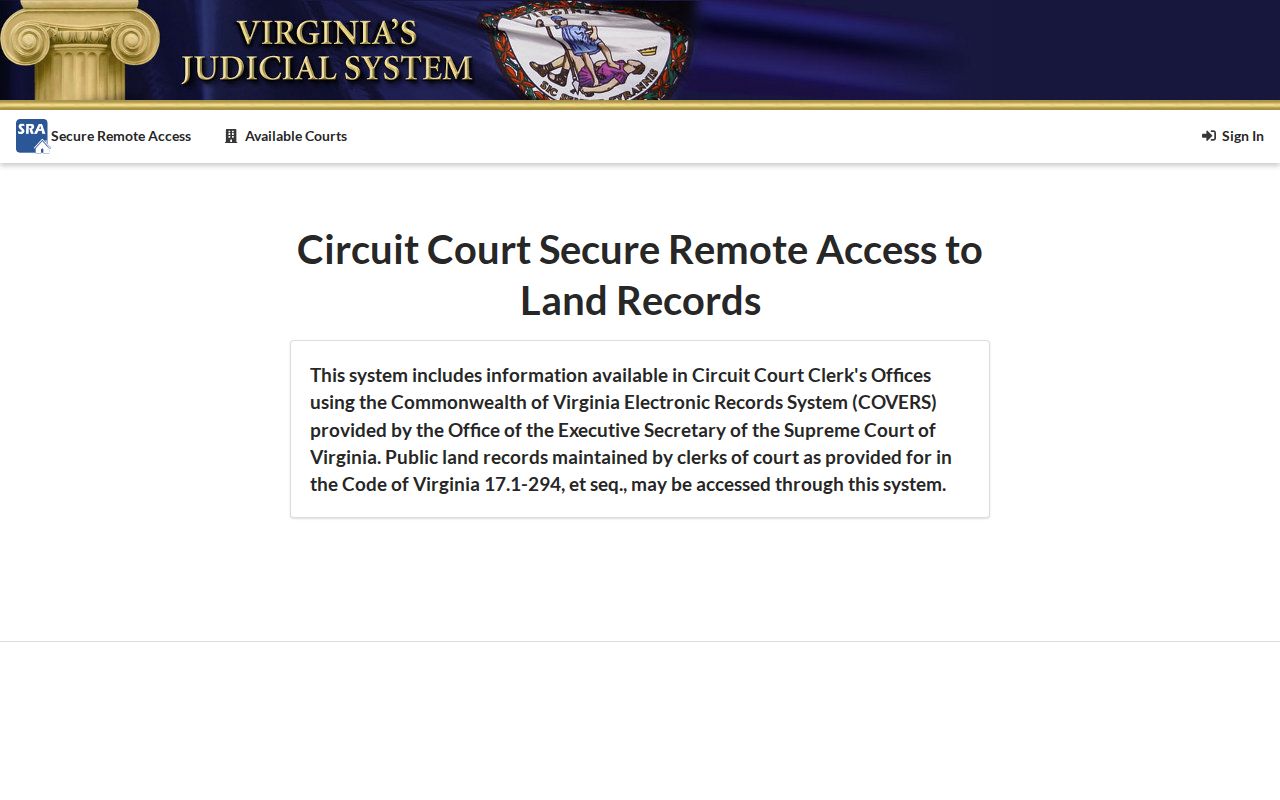
The SRA landing page displays the official entry to the statewide system, not a Pulaski deed search result or an image.
Ask the Pulaski Circuit Court Clerk
The Clerk's office sits at 45 Third Street NW, Suite 101, Pulaski, Virginia 24301. General office hours run 8:30 a.m. to 4:30 p.m. on weekdays. Deed recording ends at 4:00 p.m. Deeds may be presented in person, by mail, or through e-recording. Visitors pass courthouse security on the way in. Call 540-980-7825 before a trip. Do this if the request depends on a particular book, copy type, or counter service. For an older or unclear citation, gather the essentials first. These include the county, the approximate year, grantor or grantee, parcel or legal description, and any book and page clue. Ask whether a public terminal can display the volume. Ask what copy or certification charges apply. The Clerk publishes no current copy-fee schedule locally, so confirm the amount instead of guessing. Current hours and recording details appear on the Circuit Court Clerk's official page.
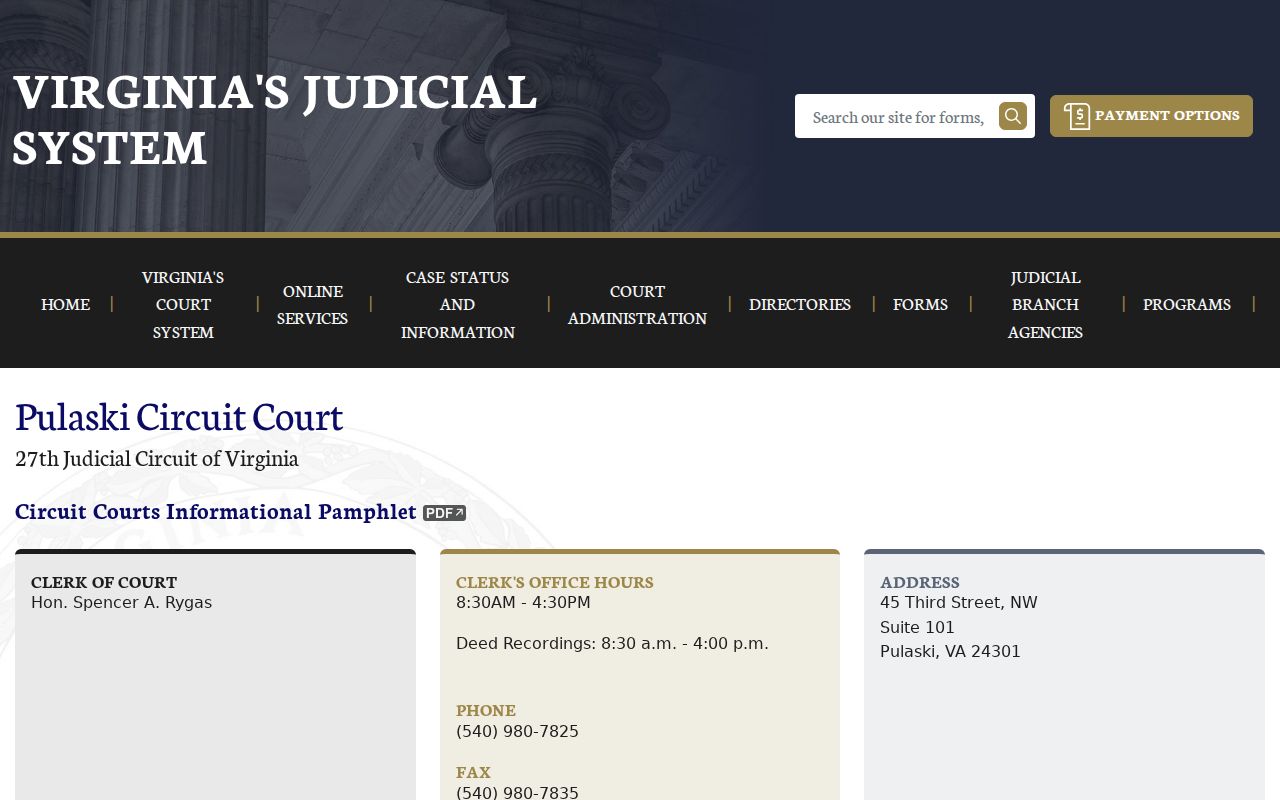
The Clerk's official page posts the current schedule, while the office itself can confirm terminal and copy procedures.
Pulaski Deed Books Begin in 1839
The Library of Virginia catalog lists Pulaski Deed Book 1 covering 1839 through 1846. The run continues through at least Book 16 for 1894-1895. That marks the earliest documented book run. It is not a published cutoff for the online SRA index. Older books can be requested or identified through the catalog. Many reels are marked for interlibrary loan. Cite the book and the year when asking staff to retrieve a specific record. Early volumes hold more than modern property transfers. The catalog notes mechanics' liens in Books 5 and 6. It also lists crop liens and title bonds in Book 7, and title bonds again in Book 14. A deed-chain search should follow those adjacent instruments whenever the question involves a secured claim, a transfer promise, or a later release. The Library of Virginia Pulaski finding aid lists the microfilm book range and related town records.
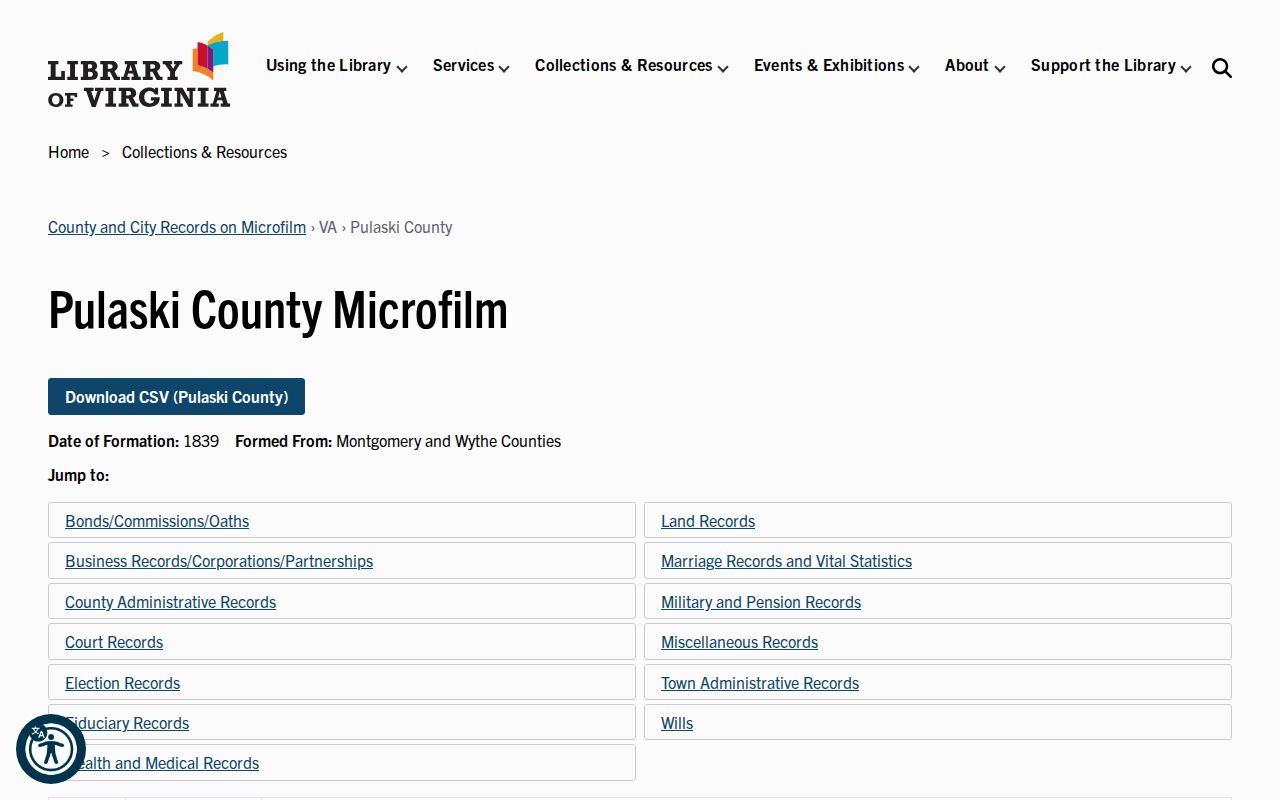
The catalog finding aid helps locate paper-era records, with reel and volume details worth verifying before an archive visit.
A 2023 Grant Preserved Pulaski Land Indexes
Pulaski County landed a preservation grant in 2023. A county newsletter put the Library of Virginia award at $57,852 for Circuit Court Records Preservation work. The funded work covered the General Index to Deeds N-Z, including Grantees A-Z. Wills from 1839 through 1909 made the list. Marriage licenses from 1895 through 1907 and Plat Book 1, covering 1892 through 1949, were also named. The Clerk scanned every deed and will book. Those scans sit behind SRA and carry a fee.
The grant tells a researcher more than a vague "old records" hint. That beats a broad lead. If an online search misses an older transfer, name the specific index group or volume range when you ask the Clerk or the Library of Virginia. Preservation made the material far more usable, but it did not lift the restrictions on remote images.
Search Beyond a Pulaski Conveyance
One chain can hold many conveyance deeds. Look past the straight sale. Deeds of trust, assignments, releases, easements, restrictive covenants, judgments, mechanics' liens, partition orders, and probate instruments can all appear in the index or be referenced by the deed itself. A release often hides under the lender's or claimant's name. Search both parties, not just the landowner.
An LLC in the record adds a step. Compare the entity name in the deed against the SCC listing, then return to the land record to see who signed and in what capacity. A deceased owner opens more files. Look for a will, fiduciary file, sale order, or executor deed. The Circuit Clerk holds those related court and land records, and the index entry alone may not show the whole disposition.
Pulaski Town Boundaries Leave Deed Clues
Old boundary work in Pulaski can turn on names. The Town of Pulaski charter points researchers to Chancery Order Books 20, 21, and 24, at pages 197, 42, and 134. Those orders matter when a description says Pulaski Station, Pulaski City, or Martin's Tank instead of a modern mailing address. That separates the corporate line from the postal name.
Subdivisions leave their own trail. Pulaski's UDO requires source-of-title information tying a plat to a deed book and page or a land-record number. That link works backward. It carries a current lot to its parent tract. A recorded plat clarifies how lots relate, though it never turns the tax parcel outline into a survey.
Get a Pulaski County Deed Copy
Start any copy request with the Clerk's SRA settings. Check for the entry or image there first. The agreement covers paid remote access for approved Virginia-licensed business subscribers only. The public material lists no free image route. No current copy-fee schedule appears there either. At the courthouse, bring the parties, an approximate year, the legal description, and any book, page, or instrument clue. Mail and e-recording both work for presenting deeds. Ask the Clerk about the process for a research or certified copy.
A full chain review rarely stops at one document. Expect to pull the source deed, later releases, referenced plats, and any court or probate orders. Log each reference with its recording date and custodian. Title questions belong with professionals. Lien and boundary disputes do too. Take those documents to a title professional, an attorney, or a licensed surveyor.
The SRA agreement itself spells out inquiry-only access for approved business subscribers at $600 per year. Sharing or redistributing credentials or data is restricted, and approval is limited to applicants licensed to run a business in Virginia. A homeowner or casual researcher should ask the Clerk whether a public terminal or another copy route exists before assuming the remote account is open, and confirm current terms with the office.
Recorded, not guaranteed. The Pulaski County index reports documents recorded with the Clerk; it does not prove that no unrecorded interest, unreleased lien, or boundary issue exists. A recorded deed is not a title opinion.