
What Pulaski County Property Tax Records Show
Value and payment records sit in different offices. The Commissioner of the Revenue keeps the assessment roll and the parcel card. The Treasurer tracks what is owed, paid, or delinquent. The two offices do not swap duties. An appeal form confirms the split, showing separate fields for land, improvements, and the total assessment, so read the online card beside the form rather than assuming its exact field labels.
| Field | What It Shows | Where |
|---|---|---|
| Land, improvements, total | Assessment components used in the appeal form. | Commissioner of Revenue |
| Owner for the roll | Ownership is set as of January 1 for assessment purposes. | Commissioner of Revenue |
| Tax bill and payment | Amount owed, paid, or delinquent for the tax account. | County Treasurer |
| Tax relief application | Elderly or disabled relief forms and their filing period. | Commissioner of Revenue |
| Historical assessment | Certified values by requested year, subject to the office's indexing method. | Commissioner of Revenue |
An assessment is a value set for local taxation. It is not a sale price. The Treasurer's bill is a different document entirely: it applies the local tax rate and any relief to that value, producing the amount actually due. A recorded deed can add transfer details or consideration, but none of these records stands in for another. Use each one for its own question.
Pulaski County's Six-Year Assessment Cycle
A contracted appraisal firm performs a countywide reassessment every six years in Pulaski County. The most recent effective date is January 1, 2021. That date anchors the current roll. It does not promise each parcel matches today's market. Under professional standards, the assessor's work covers discovery, listing, classification, and fair, equitable assessment across the county.
The assessment exists to build the tax roll. With a value question, compare the land and improvement figures against the property's recorded history and physical facts. With an amount due, move to the Treasurer's account. For a true market opinion, seek a qualified appraiser rather than treating the assessment as an appraisal.
Changes Between Pulaski Reassessments
Between six-year cycles, the work continues. New construction, improvements, transfers, subdivisions, and other property changes can each trigger an interim assessment adjustment in Pulaski County. So can information the office newly finds. A parcel can shift mid-cycle. Without a property change or new information, correction authority generally reaches only contractor clerical errors, the county says.
Timing runs on several tracks. Property cards update digitally each month, and survey maps change weekly. A recorded transfer may reach the Clerk's index before the card refreshes, while a map edit can post on a different date than an assessment change. Keep the assessment year, recording date, and map update beside each number you compare.
Look Up a Pulaski County Tax Bill
The Treasurer posts its tax search in a separate payment application. Search by address. An account or parcel number works too. Once the right account appears, confirm the tax year, the amount due, and the payment status on the live result. Similar addresses can hide the wrong account. If the parcel key is unclear, ask the Treasurer before paying.
- Open the Pulaski County Treasurer's tax search and identify the property or account.
- Check the tax year and read the bill or payment result shown by the live application.
- Use the assessor's card or office to ask about the assessment and any relief shown for the roll.
- If an unpaid balance appears, contact the Treasurer about the account and current status; do not infer a sale from a balance alone.
- Assessed value
- The assessor's tax value for land and improvements; it is not a sale appraisal.
- Tax bill
- The Treasurer's account showing the amount due or paid for a tax period.
- Tax relief
- A program that may reduce a qualified taxpayer's local tax burden; Pulaski lists an elderly and disabled application period.
- Tax lien
- A recorded or statutory claim tied to unpaid tax; confirm the parcel and release with the proper custodian.
The county's Treasurer tax search is the live payment route.
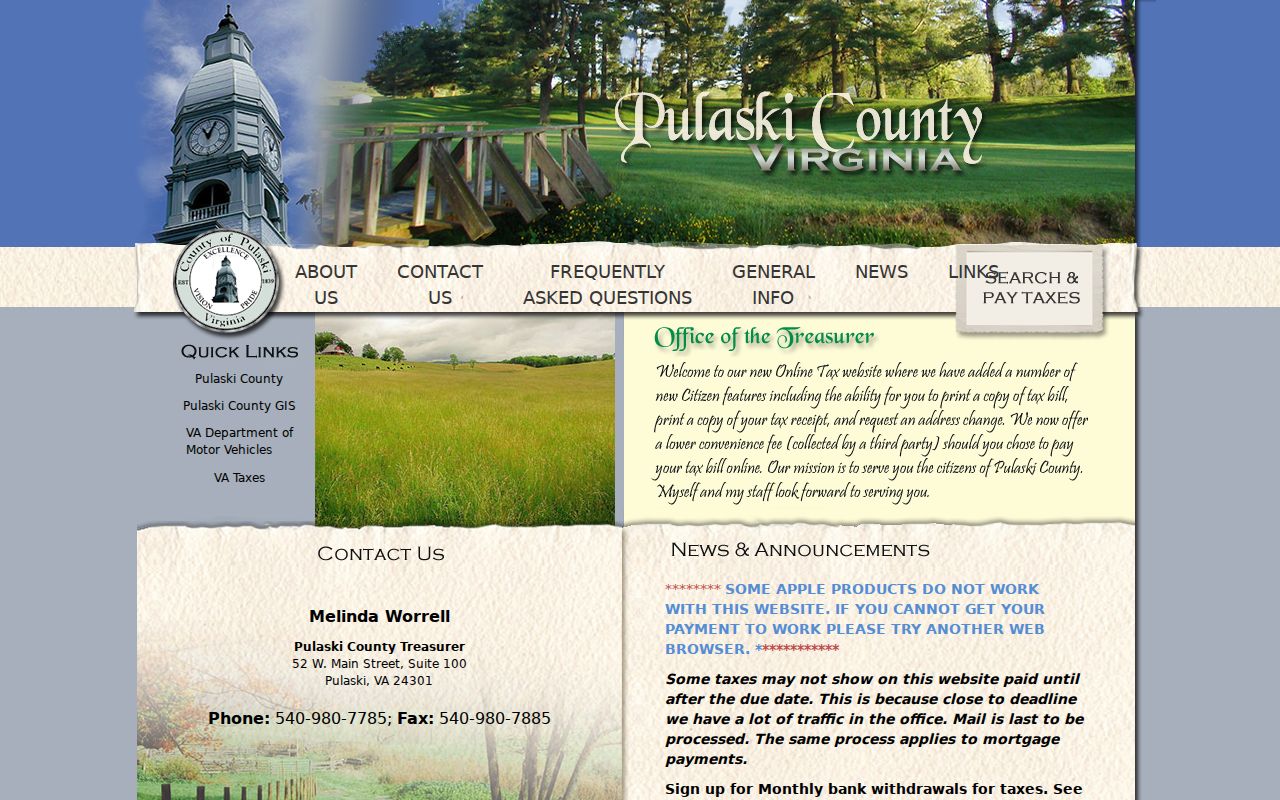
The tax search loads inside the Treasurer's online application. Confirm the available fields and the current balance there in the live tool.
Assessment and Payment Have Different Keepers
Two offices split the duties. The Commissioner of the Revenue handles value, parcel-card details, and assessment questions. The Treasurer handles bills and payments. The Treasurer cannot change an assessment, though. An unexpected bill deserves a quick sort. Is the fight about value, or about a balance? Then send each issue to the office that owns it.
The Treasurer's office sits at 52 West Main Street, Suite 100, Pulaski. It answers at 540-980-7785. The county's tax-search link and relief instructions appear on its Treasurer page.
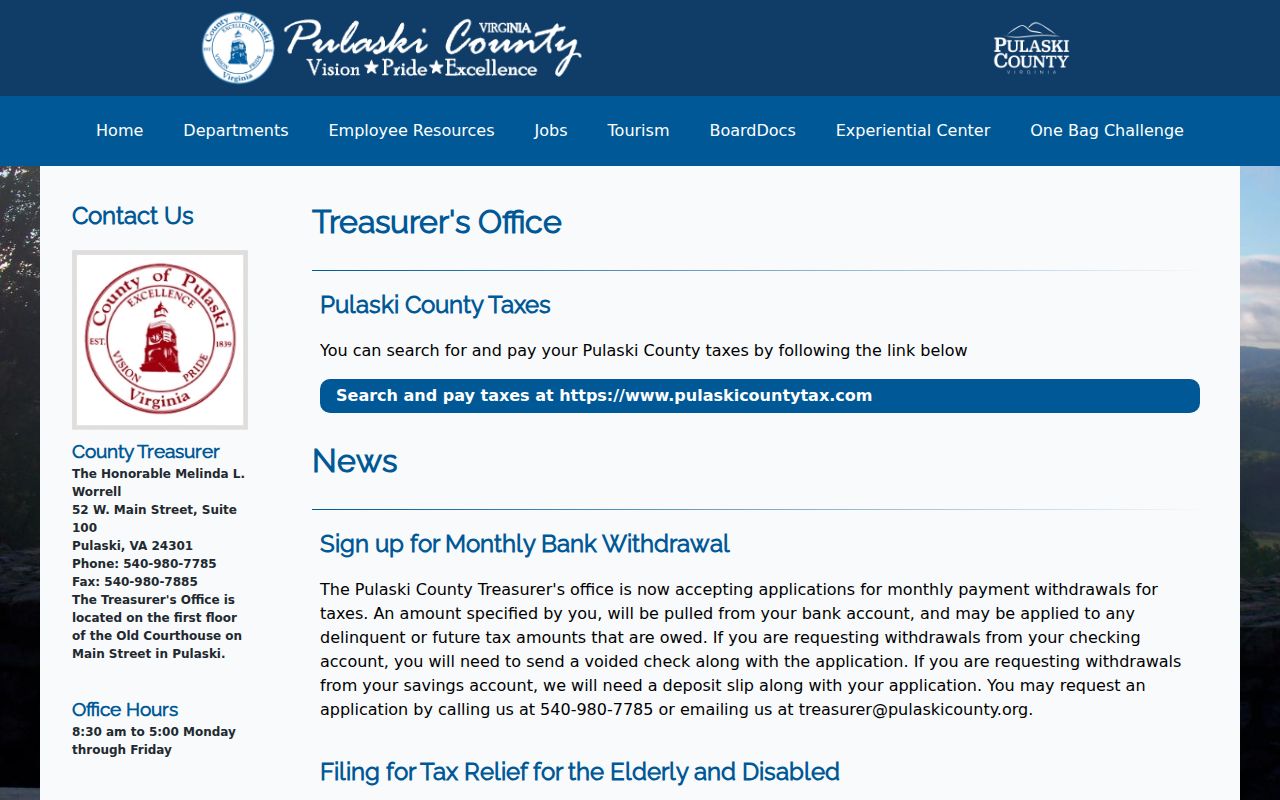
The page routes bill and relief questions; it never changes the assessor's valuation.
Pulaski Tax Relief Has a Set Filing Period
Pulaski County offers tax relief for elderly and disabled applicants. Forms go to the Commissioner of the Revenue. The filing window runs January 1 through April 1. The Treasurer takes tax questions and monthly withdrawal applications. Relief eligibility belongs to the Commissioner. The county publishes no full exemption menu or detailed thresholds, so confirm current form instructions with the office.
Have the parcel or account key ready. Ask which form fits the year in question. If the matter is an existing bill, the Treasurer covers payment status. Never assume an exemption on an older assessment carries forward, and do not expect the tax bill to explain the underlying property value.
Historic Pulaski Values Before 2000
The county's historical assessment form asks for the owner or owners in the year requested, any prior owner, tax-map reference, physical address, and the years sought. Use the owner as of January 1 of that year, not today's owner. For a request for 1990, for example, name whoever owned the parcel on January 1, 1990.
Pre-2000 assessment records are sorted alphabetically rather than by tax-map or account number. The office can return certified historical values by postal mail, fax, or email; the form does not state a fee or response deadline. Provide enough identifiers to distinguish a parcel that has changed ownership, been split, or received a new address.
The historical assessment request form sets out those search details.
Appeal a Pulaski County Assessment
The county appeal form asks for the tax-map reference, legal owner, agent if applicable, mailing address, property street address, and the land, improvement, and total assessment. Factual description errors count as grounds to document. Acreage, condition, building size, bedrooms, and special features all qualify. Records or other evidence should show which property facts are wrong.
The deadline is whatever date the mailed assessment-change notice carries. There is no single annual date for every parcel. A financial impact or the percentage of change, by itself, is not enough. The county notes that a missed reassessment-team or Board of Equalization route may proceed to Circuit Court under Va. Code § 58.1-3370, and a factual land-record correction may be made under § 58.1-3981.
When a parcel was divided, combined, or renumbered, keep the prior account or tax-map reference beside the current one. Compare the legal owner, situs, and legal description on the notice and the card. Then check any recorded plat or deed that explains the change. An appeal routes fastest when it names the exact field in dispute, the year involved, and the custodian responsible for that fact.
Appeal window. Follow the date on the mailed assessment-change notice and use the county appeal form. The form does not state one universal deadline, so contact the Commissioner promptly if the notice is missing or unclear.
Organize a Pulaski Tax Review
Get organized before you contact any Pulaski County office. Write down the parcel or tax-map reference, situs address, tax year, and the exact question. Keep the assessment-change notice. Its date controls the stated appeal window. The county form separates legal owner, mailing address, physical property address, and any agent. Those fields matter when the tax bill goes to a different address. They also matter when a representative writes for the owner. A clear first request keeps a payment question from being routed as an assessment challenge.
A factual assessment concern starts with comparison. Set the county card and notice beside the property's actual description. The appeal form asks for land, improvement, and total figures. It flags description issues like acreage, condition, building size, bedroom count, and special features. Note which fact seems wrong. Note what the record currently shows. Note what document or observation supports a correction. The county says a percentage increase or financial impact alone is not enough. Ask the Commissioner which evidence fits the particular field. Do not assume a bill, photograph, or sale document settles every valuation question.
Keep tax payment records separate from valuation evidence. The Treasurer can confirm a balance, receipt, or payment history. It cannot revise the assessment. The Commissioner handles parcel-description and value questions. For a past-year owner or amount, use the historical assessment request. Supply the January 1 owner for that year. Pre-2000 entries run alphabetically rather than by parcel number. Records missing online are not lost. Ask the custodian for existing documents and an estimate before ordering copies.