
Build a Pulaski County Ownership Timeline
Several record groups hold former owners. The Clerk's SRA system carries scanned deed and will books, but Pulaski does not publish its earliest online index year. The Library of Virginia catalog anchors the paper era.
| Record group | Known span | Custodian or route | Use in the chain |
|---|---|---|---|
| SRA/COVERS land books | All Pulaski deed and will books scanned; index cutoff not stated. | Circuit Court Clerk / Virginia SRA | Search current and earlier conveyances when available. |
| LVA deed-book microfilm | Book 1, 1839-1846 through Book 16, 1894-1895. | Library of Virginia catalog and microfilm | Identify paper-era deed and lien volumes. |
| Plat Book 1 and index | Plat Book 1, 1892-1949, included in preservation work. | Clerk and Library of Virginia leads | Connect lots to recorded subdivision descriptions. |
| Historical assessments | Request by selected year; pre-2000 files alphabetical. | Commissioner of Revenue | Identify the January 1 owner used for that year's roll. |
For recent transfers, begin with the Clerk's index and move to the underlying deed. For older Pulaski owners, cite a book and year from the LVA finding aid, then ask the Clerk or archive to locate the reel or volume. A historic tax assessment can add a year-specific owner clue, but it is not a deed and the form requires the owner as of January 1.
The Library of Virginia catalog for Pulaski County lists the early book range and town records.
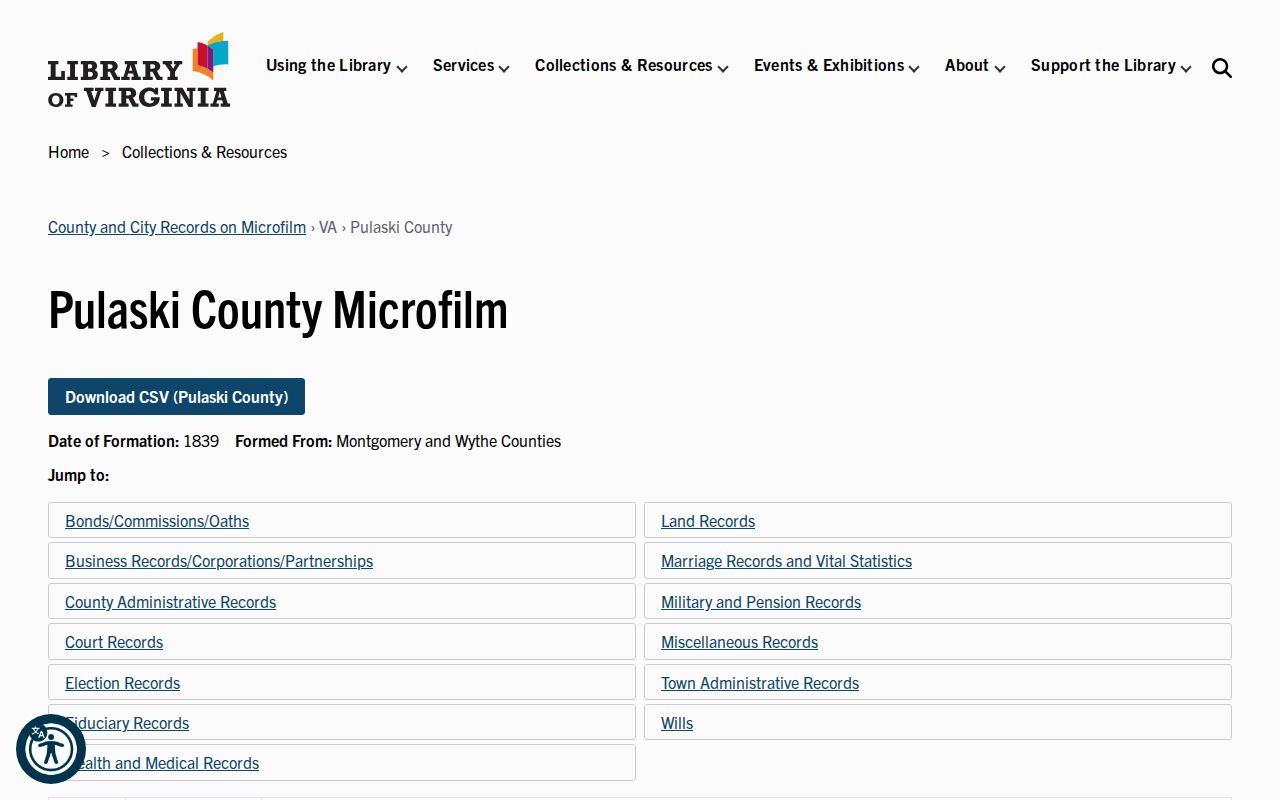
The finding aid's citation unlocks microfilm or courthouse requests.
Walk the Pulaski Deed Chain in Reverse
Walk the Pulaski County deed chain backward, starting with the most recent grantee. Each deed's grantor becomes your next target. Keep the description, date, book and page or instrument reference, and party names together. A name-only property search can miss a transfer. That happens when a spouse, company, executor, or trustee acted in a separate capacity.
- Start with the current parcel key and owner line from the county assessor card.
- Find the newest recorded instrument in which that owner was grantee.
- Read the grantor and legal description from the instrument.
- Search the earlier grantor as a grantee and compare the parcel description again.
- Continue until the description changes or the index reaches an earlier paper volume.
- Grantor
- The prior party who conveyed the interest.
- Grantee
- The party who received the interest.
- Chain of title
- The linked sequence of recorded transfers for the parcel.
- Legal description
- The land description in the deed or plat, which can be more useful than a modern street address.
Early Pulaski Books Mixed Land Records
Pulaski County deed books begin in 1839. That was the year the county itself was formed. The LVA catalog shows those early volumes mixed more than land conveyances, so an old owner search may turn up documents well beyond a simple sale. Book 5, spanning 1870 through 1874, included mechanics' liens, officials' bonds, and title bonds. Book 6 held mechanics' liens too. Book 7 carried crop liens and title bonds. Book 14 recorded title bonds as well. When a name surfaces in a Pulaski County deed book without a straightforward sale behind it, the index entry usually explains why: read its document type and related references, since a lien, title bond, or later release can account for the appearance. The LVA finding aid pinpoints the volume, while the Clerk's land index or a courthouse route supplies the recorded context.
Pulaski's 2023 Preservation Work Opened Leads
Pulaski County's Clerk landed a $57,852 Library of Virginia preservation grant in 2023, announced in a county newsletter that July. The funded list is refreshingly specific. It covers the General Index to Deeds N-Z, including Grantees A-Z, wills from 1839 through 1909, marriage licenses from 1895 through 1907, and Plat Book 1 from 1892 through 1949. Every deed and will book was scanned for SRA.
That opens real leads for former-owner research. A stalled name search gains new paths when you ask for the index range, a will record, or Plat Book 1 directly. "Old deeds" alone is too vague a request. Ask by volume and year instead. Scanning does not equal open access, though; the images remain governed by the Clerk's current SRA rules. The Virginia SRA land-record portal is the official remote entry point.
Pulaski images here still need the approved local subscriber route.
Probate Files Filled Pulaski Chain Gaps
Death stops an owner, not the chain of title. The property history can keep moving through a will, a fiduciary account, a sale order, a partition order, or an executor deed. Pulaski Circuit Court Clerk records include wills and fiduciaries. The LVA catalog lists Will Book 1 covering 1840 through 1859, plus later volumes. An estate file can surface a representative or a sale that an ordinary deed search never shows.
Probate is the detour worth taking. Work the recorded deed into the probate case, then go back to the land index for the instrument that conveyed the parcel out of the estate. Vital certificates sit with the Virginia Department of Health. Those carry their own privacy periods. For proof of transfer, the will, the order, and the recorded conveyance are the sources that matter.
Historical Tax Values Used January Owners
Pulaski County asks for precision on this form. The historical-assessment request wants the owner names for the year sought, the prior owner if known, the tax-map number, the physical address, and the year or years requested. The correct owner is the one on record January 1 of that tax year. Before 2000, land books sorted alphabetically rather than by tax-map or account number.
Certified historical values can come back by mail, fax, or email, though the form gives no fee or deadline. Treat it as a year marker. It is not the deed that vested title. A historical value cannot substitute for a recorded deed. When a parcel split or a name change complicates the history, send both the old owner and the current parcel details, using the county's historical assessment request form to spell out the required identifiers.
Old Pulaski Names Shifted the Search
Pulaski went through several names. It was Pulaski Station first, then Pulaski City in 1886, and finally Pulaski in 1888. County history also points to Martin's Tank as the place before incorporation. Dublin grew around a railroad depot in 1854. Newbern and Snowville both appear in the county's settlement story too. A former owner's deed may carry one of these names. It may not carry a street number you recognize.
Pulaski town minutes cover 1886-1910, and the town ordinance book covers 1916-1949 on LVA microfilm. Both can supply street, use, or boundary context. That helps when a legal description is hard to place. The library and archive are the right places to ask about city-directory coverage. Any given era can be checked that way.
Walking the Pulaski County Deed Chain Backward
Start with the newest recorded deed, not a random hunt through every historic name. Work backward. Copy the current grantee, the grantor, the recording date, the deed book and page or instrument number, and the legal description. Next, hunt that earlier owner as a grantee. Then repeat. At every step, confirm the instrument describes the same parcel or a documented parent tract. A changed owner name alone never links two deeds.
- Find the most recent deed and capture the grantee, grantor, record reference, and legal description.
- Search the grantor's earlier deeds as a grantee, limiting the date range to before the transfer you found.
- Compare acreage, lot references, adjoining land, and source-of-title citations to confirm the chain follows the same tract.
- For older entries, use the Clerk's index and Library of Virginia microfilm; the remote index cutoff was not published.
- Grantor / grantee
- The party conveying an interest and the party receiving it in a recorded instrument.
- Chain of title
- The ordered sequence of recorded instruments tracing interests in the same land.
- Legal description
- The written land reference used to match historic records when a street address has changed.
How Far Back Pulaski Owner Records Reach
Pulaski County deed books reach back to 1839 in the official archival catalog. The online SRA index does not state its exact earliest year on the county pages. So no fixed remote cutoff can be stated. For an old parcel origin, begin with the land index. The Library of Virginia catalog then points to the right book or microfilm reel.
A later plat can cite the deed behind it. That citation points to an earlier owner of record. The county UDO requires source-of-title information in subdivision materials. Pulaski's charter sends boundary searches to Chancery Order Books 20, 21, and 24. Wherever the chain crosses an estate, a split, or an old town name, record the reference. Verify the land description at every transfer.
Lawful use. Former-owner research in Pulaski County supports property history, title review, and purchase diligence. Do not use record details to track, threaten, or harass a living person.